Co-curated by
Connie Ashford & Katya Hudson
Connie Ashford & Katya Hudson
Colloquy p.1
Bolding at Alfie’s Antiques
5 - 13th September 2026
Bolding at Alfie’s Antiques
5 - 13th September 2026


With Nassim L’Ghoul & Jacob Bullen
Exhibition text
The water dulled any noises from above to little more than remote echoes. The movement of the world outside was similarly blurred to indistinguishable moving lights and shadows. In the small pond where she lived, amongst a school of others, hour to hour, there was no change, no problems or discomfort, each day followed the same distinguishable pattern. It could have as easily been days as months or even years that this went on, time spent swimming round and round in circles, with not much to do but to look down at the pool’s pebbly bottom.
Every so often flakes of food floated from above; from where or whom or what or why, this nourishment had come, she didn’t pause to wonder. Instead, she just devoured it quickly and, it must be said, with much gusto. Even if she’d thought to question from what or where it had come, the round and round all-day all-night had left her mind not unlike a sieve. By the time she would have circled just one round around the tank to think; the thought would have gone: dissolved into the pond water, like a sugar cube stirred into tea. She didn’t know, but it was also so, with many and any of her conundrums, particularly when they went against the groupthink mentality floating through the waters currents.
And so her days, their days, her days, drifted by, amidst the pond of pebbles, that is until — out of the blue and from above — she felt a sudden impact. Right between the eyes, the heavy object struck her by surprise, not drawing blood, but hard enough to jolt her out of orbit. She was now swimming counterclockwise, not that she had had the time to notice.
As she went round, and as her eyes adjusted, they focused on the thing which hit her. She realised the thing was a thick and heavy book, which continued its descent, now slowly, letting off a small stream of bubbles as it landed, at rock bottom, with its pages open. With her head still pounding, she swam and began to try to read it.
kɒləkwi. Huh? For a minute she considered giving up and swimming back, to commence the habitual looping that was easy and, to which she was well accustomed. But resisting this urge, she continued, not without difficulty, but with all the strength she could muster. KOL-kooeyY kalieurkowoo KOL-uh-kwee
Colloquy
kɒləkwi
Linguistically, colloquy implies some kind of formal gathering; a serious, high-minded discussion on matters of importance. We might imagine boardroom debates, transcript readings, or philosophical references designed to extract the ultimate truths.
She turned up to look at her fellow fish, who had taken no notice of events and had just continued circling.
Etymologically, colloquy derives from the Latin word colloquium (from com- meaning «together» + loqui meaning «to speak»). In the simplest of terms, it is a coming together to speak.
She looked at the pebbles and asked coming together? But the pebbles, remaining resolutely uniform and inanimate, didn’t answer. Trying to lay these thoughts at rest, she found she couldn’t bear it any longer. She realised she wasn’t going to get anywhere in this echo chamber, so, she swam up; up to the very top, and popped her head, for the first time, out of the water.
It was brighter up here, and the noises were louder than they had been when her head had been under; she found herself overwhelmed by all the hubbub. She was, in what looked like a warehouse structure; with corridors leading to corridors, a maze of rooms filled to the brim with objects; books, lamps, tables, watches, jewellery, clothes, trinkets, souvenirs: all manner of exceptional curiosities. All this ephemera, colour and noise made her feel like she’d spent her life in a vacuum. As someone walked past, she heard them say something about someone called Alfie. Maybe he was the one whose book had hit her? She’d rather like to tell him all the discomfort it had caused her, but before she thought of how to ask the question right, the people who had said it had moved past her. They went up, up the stairs, which circled the pond, and she had no way to know where they were going. In all this excitement she had not realised that up here she struggled to breathe and by now her little gills exhausted, and so, not by choice, but by necessity, she went back under.
As the weeks moved on, and popping out became routine, she found at holding her breath she was improving. There was plenty to see; rooms filled with people, with objects: whose value seemed to be constantly shifting. Amidst the stalls, with bulging walls, she noticed the one that was opposite her seemed contrary. It looked empty; not filled at all. If the rest of the rooms shouted, then this one was a whisper. However, one morning, or maybe it was afternoon, she noticed that people had gathered. What were they looking at? Annoyingly, she couldn’t see from this angle. Instead, she had to made do; tuning into the weird-sounding things that the people were saying.
Yeah, but how do you say it? It makes me think of something religious, but also alien;
I am not sure, maybe like a cult – or some kind of ritual
Like the candles we light in churches; do you have a lighter, by the way?
The grid-like structure reminds me of engines and machines,
Do you think that it’s a bath of milk?
No, no, it’s much more mythical, like I think it’s about spells and manifestations.
A comic? No two-panel narrative.
A liminal space,
I think you’re deep-ing it. Can you play chess?
I learnt it from my dad
It doesn’t make any sense
It makes total sense
I feel bad for that little piglet
Consumer goods, en masse candles aligned in geometric structure
Where do the wires actually go?
It makes me think of, do you know… what’s.. that book by Levi Strauss?
The question mark is oddly satisfying
Memories or computer renderings?
Classifications, associations, incidental, incremental.
The key: where do you think that it goes?
I cannot see
The toilet? Well, you just have to go up the stairs,
No, it!
Oh just step closer.
She wasn’t sure of all this; she felt like a fish out of water; it all sounded like mad ramblings.
But it was also interesting, exciting, strange; something that she felt she wanted to be part of.
*
You have just read a story about a fish; it likely brought up more questions than it answered. Rather than carving a path to any fixed knowledge or tidy certainty, Colloquy is an exhibition in three parts; an invitation to swim up and participate against the contemporary current.
In turning away from spectatorship and into participation — as witnesses, collaborators, or even adversarial opponents – we hope you too can join the conversation.
Colloquy p.1 is an exhibition with Nassim L’Ghoul and Jacob Bullen, which runs from
Co-curated by
Connie Ashford & Katya Hudson
Connie Ashford & Katya Hudson
Mirrors that eat us
Chisenhale Studios
June, 2026
Chisenhale Studios
June, 2026


With Gem Bryant, Tegan Chinogurei, Kate Hardy, Kirsty Harris, Jeremy Hutchison, Kumbirai Makumbe, Aylin Leipold, Aimée Lyon, Iman Samuels, and Babette Whiting.
Exhibition text
“The spectacle aims at nothing other than itself.”
— Guy Debord, The Society of the Spectacle, 1967
“Mirror, mirror on the wall, who is the fairest one of all?”
— Wicked Queen, Snow White, Disney, 1937
How often are we forced to face some form of our reflection? Scientists suggest that we might see ourselves from eight to eighty times on any given day. If we begin to consider the front-facing camera, the photos, and the social media accounts, how much higher is that number? What about the self-help books, podcasts, and blog posts which encourage some form of introspection, a need to reflect? The number doubles, triples and quadruples, like a funhouse mirror room, reflecting an innumerable number of potential “I”’s. These are the mirrors that eat us.
There exists, of course, the «artist myth»: a collection of romanticised, damaging stereotypes, the «tortured genius», which frames creativity as a solo, innate gift born of suffering. If we are living in the “age of individualism”, what if, rather than reflect, we decided to refract? Refraction is the bending of a wave as it passes from one medium to another, a process not altogether dissimilar from that of the artist, who bends material into meaning. The studio, then — not the museum or white gallery walls — is the place of this bending. What then does it mean to exhibit in this architecture?
Set in Chisenhale Studios, Mirrors that eat us brings together eleven artists who work across collage, sculpture, oil painting, and assemblage. Here, it is the artist who becomes the “myth-maker”: bending the world to examine alternative possibilities of looking. There is no one direct response to the title of the exhibition; rather, artists propose their own distinct questions, which oscillate between themes of devotion, memory, collection and documentation. Exhibited together, the works form an orchestra of overlapping “what-ifs”, unbalancing a variety of previously undisputed societal scripts.
A slippage from uniformity is tangible in Makumbe’s LGBTQ (Let God Be True Quickly) (2025), which actively engages with processes of fabulation. Foregrounded in the spiritual/theoretical framework “You”, which treats divergence as sacred, the ellipse form manifests as a symbol of the self-conceived belief system.
In the same thread, in a series of assemblages entitled Songs of Faith (2023 - ongoing), Bryant transposes symbolism onto mundane objects, which might have otherwise been discarded. While retaining their outward physical appearance, objects infused with sentimental meaning become displaced from their initial purpose and take on the qualities of talismans or reliquaries, forming a living archive of Bryant’s family.
Building on the themes of devotion, It could be Me (2024), presents the national lottery as an artefact. In this sculpture, Chinogurei exaggerates the phenomenon of seemingly timeless ideas of “cheap luck” and “easy money” within working-class areas. The stained plaque acts as self portrait as the artist’s position and/or the black community amongst white working-class England.
The disciples at the last supper look on in awe at the model-train magazine centrefold in Whiting’s Junk Shop Realism (2026). In this assemblage, faith is directed through the lens of hobbyists — a reflection on devotion within fans and collector cultures. Can meaning be found in incidental
coalenscence?
This question, too, is taken up in The lover of the year (2026), which stages found objects into a new composition, transforming their meaning into something more potent. Between the devotional and the documentarian, this sculptural work by Lyon proposes a retelling of fragmented memories, structuring collated histories to propose new potentials and desires.
Expanding from individual memory to that of a group, in Veränderungsbedürftigkeit (working title) (2026), we are invited to consider how influential historical moments might become forgotten, and why. Fourteen stills show Christa Wolf, considered one of the most influential writers in modern German history, whose work documented childhood under Nazi and adulthood in Communist regimes. In 1993, files revealed that Wolf had served as an unofficial Stasi informer between 1959 and 1962, submitting reports and meeting agents under the codename «Margarete.» Her admission sparked fierce debates regarding collaboration between intellectuals and the state in Germany. Leipold captured 14 screenshots of an interview given by Wolf just 35 days following this momentous watershed moment; she appears calm and considered.
This shift to a more sinister tone is also felt in the work of Hutchinson:
“I make art to challenge the tyranny of common sense. To rupture logic, collapse norms, and weaponise humour to political ends. The result is a form of radical absurdity, plunged through the surface of neoliberalism. A monster that devours itself.”
Through an accumulation of layered imagery, using found materials, collage and painting, form capsules of the world around us. While each frame contains an individual, interpretive narrative, together the works operate as a kind of infinite scroll.
Marking a move from the devotional to the documentarial, Sidonie-Samuels studies acts of collecting. Where Will They Keep Our Memories? uses the visual language of museum storage, merged with that of the domestic, to reimagine how we might engage with object memories. If sentimental objects hold stories and traditions around them, passed down in families, how do these memories become inaccessible once they enter the sterile conservation systems of museum settings?
First Lightning (2017) is based on the first nuclear test detonated by the Soviet Union in August 1949 at the Semipalatinsk Test Site, Kazakhstan. Displayed like a flag, the painting evokes ideas of territory, allegiance and national identity. Each square cm of linen represents 10 tons of TNT, which in turn is the unit of measurement used to denote the yield of the explosion.
Sanctuary I (2018), Harris destabilises the notion of the home as an emblem of safety and security. The depicted house formed part of ‘Doom Town’, a fabricated suburban neighbourhood, constructed at the Nevada Test Site in 1953: blown apart to study the potential effects of a nuclear detonation on domestic American life.
Also pertaining to structural destruction, Hardy navigates the worn stairs of a decaying building in Berlin Stairs. This work explores the broader emotional and physical facets of hiding and safety while preserving the crumbling structure in her print.
In contrast to acts of preservation and distillation, Soft focus (2021) obstructs the clarity of the all-seeing eye of CCTV. In the 1970s, the pornographic industry borrowed from the techniques of the silver screen, softening images by directly applying grease to the camera lens. Today, this old Hollywood technique has been applied by influencers and vloggers to a low-fi filter to create a “dreamy, soft-focus glow and hazy lighting effect”. Alluding to its previous uses, the vaseline applied by Whiting to an up-to-date dummy CCTV camera acts as an intervention between desire, surveillance, and perception.
In a performance by Chahat on the opening night of the exhibition, the phrase “I love you so much” is repeated in a continuous loop. Layered on top of electronic tracks, spoken word moves from a prayer-like whisper, into a guttering chant on the brink of breaking from exhaustion. Through repetition, the words gradually lose fixed meaning, to become a a rhythmic material, reminiscent of the pursuit of superficial gratification, through digitally-driven dopamine highs .

Co-curated by
Connie Ashford & Katya Hudson
Connie Ashford & Katya Hudson
Racecar
Safehouse 1 & 2
October, 2025
Safehouse 1 & 2
October, 2025


With Ratiba Ayadi, Madeleine Bender, Caitlin Cox, Rebecca De Las Casas, Matthew Dardart, Lenka Della Porta, Emma Guareschi, Fran Hayes, Katya Hudson, Beatty Hudson, Katie Lane, Aylin Leipold, Aimee Lyon, Rosy Schofield, Vincent Schefz, Mykyta Shkliaruk, Daisy Tortuga
Exhibition text
Racecar was originally conceived in 2020, before personal and global circumstances shifted, before we had really grown up. As life resumed in fragments, the artists followed the well-worn paths that many graduates have trodden: side-jobs, moves abroad, and the early onset of “realistic thinking”. Bringing together emergent artists within the first ten years of their practice, the exhibition primarily features those based in London, alongside other practitioners from Ukraine, France and across the UK.
Like its title, a palindrome, Racecar loops back on itself. Across a range of media, including sculpture, print, sound, and performance, the works are made from materials both temporal and lasting, tracing the passing of time and how it distorts memory, the slow drift and delay between thought and action. Rather than a fixed, linear narrative, we propose a clarity akin to memory: formed through the overlay of perspectives across shared departures. What emerges is not unlike a moiré pattern; dependent on an active relationship between the works and the viewer to align.
Taking place between the husks of two neighbouring buildings, Safehouse 1 and 2, the exposed walls and missing roof echo the incorporeal subjects traced throughout the works. As we move through the space, we find recurring narratives: fragmentation, ritual and confessions as a means of processing. Portrayed separately by the individual artists, placed together, they capture a shared experience. The works bear imprints of passing years, blurred, scratched, erased – while pauses, remnants, and unrealised proposals remain the fabric of this exhibition. An open circuit, shaped by a period of dormancy, is an invitation to revisit something you once set aside. Text by Co-curators
Yozhik v Tumani
IZOLYATSIA, Kyiv
June, 2022
IZOLYATSIA, Kyiv
June, 2022


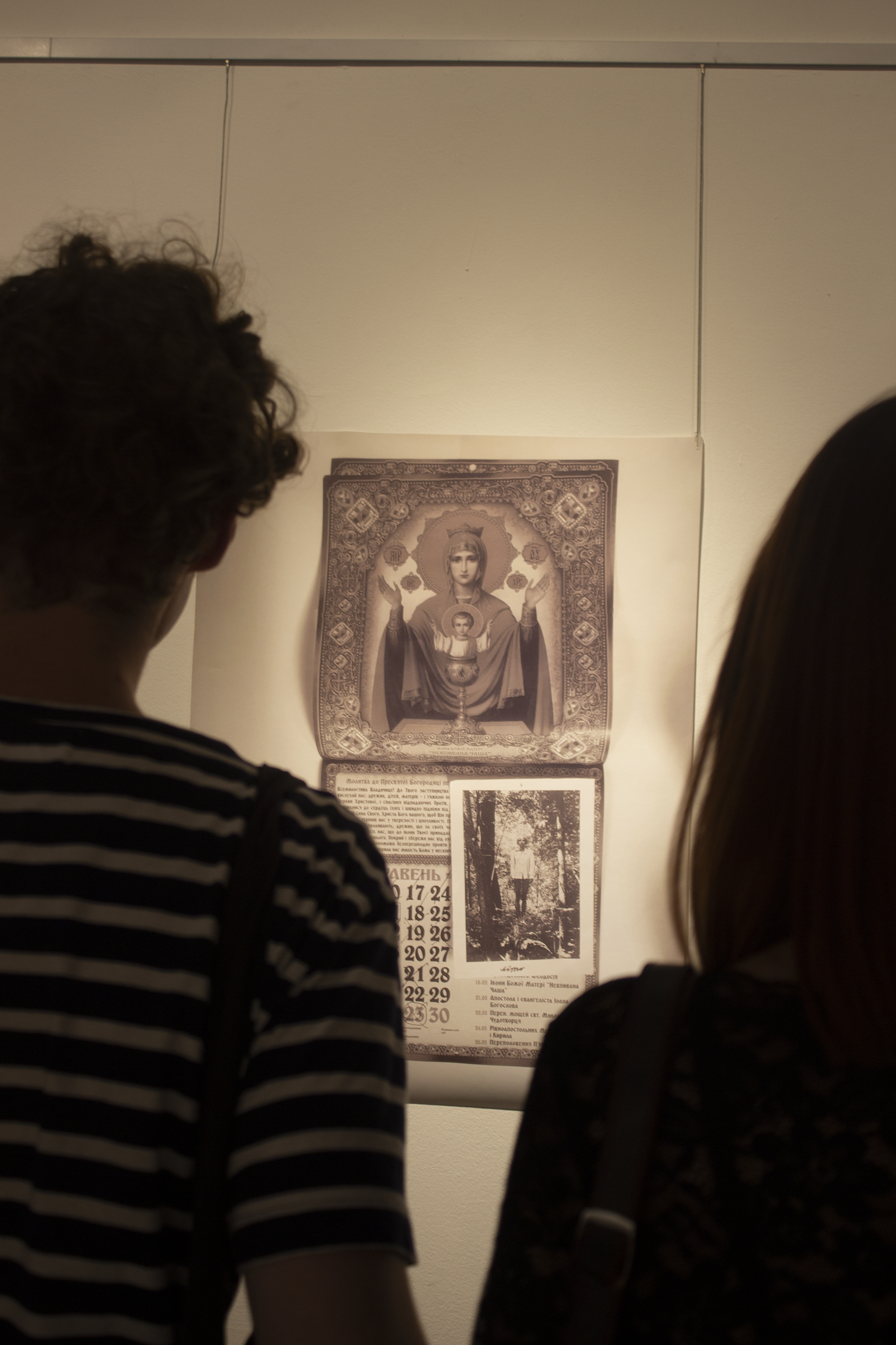


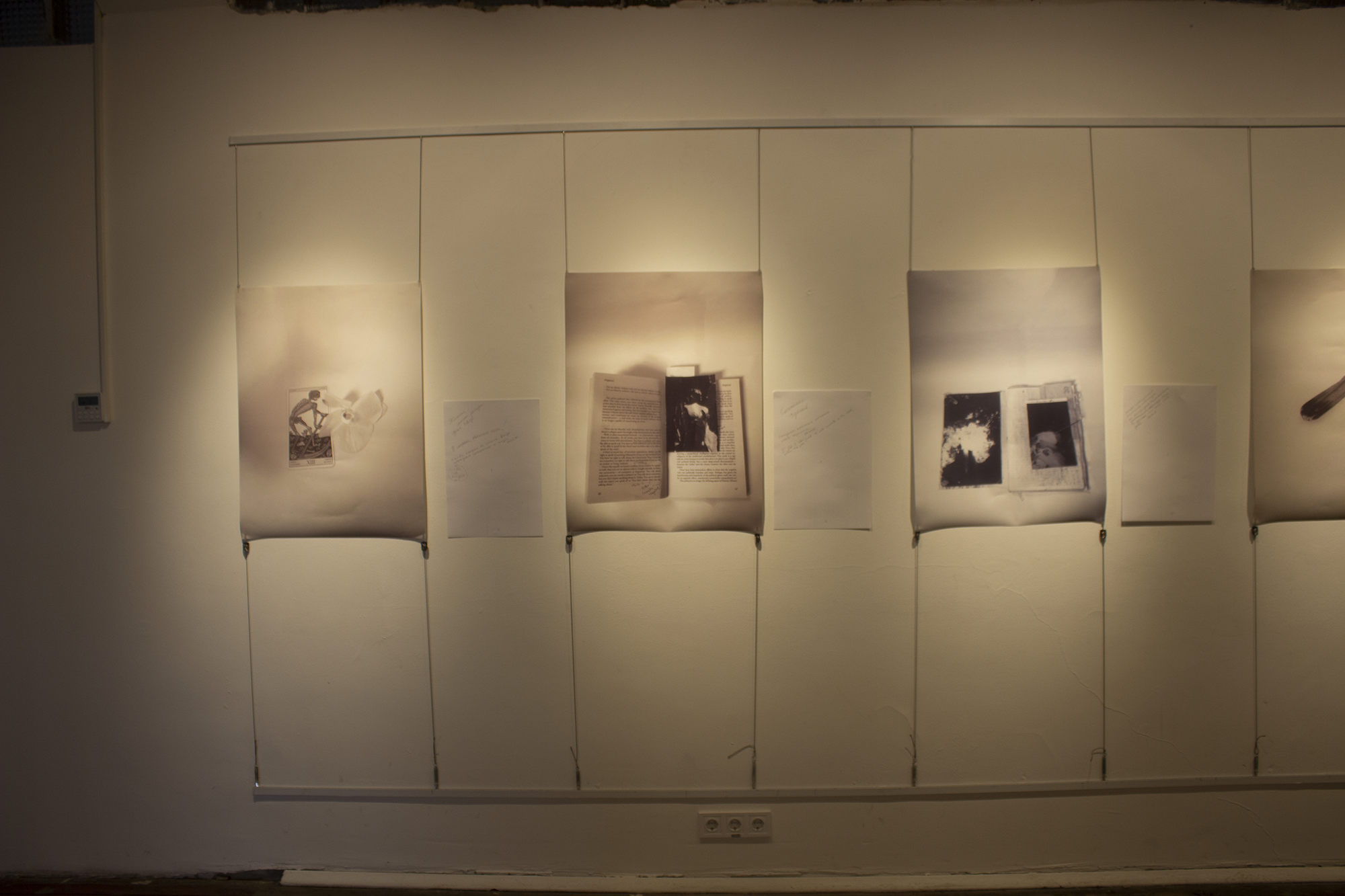

Exhibition text:
A gin-marinated audience of two sat smoking outside the emtpty bar. Steeped, in alcohol and conversation they did not notice the horse-sized dog passing by. The dog walked his owner. Moderate daily exercise. His stride was demanding, pulling along the straggly-haired man dressed in all black.
A gentle giant on the whole, Puccini made him sentimental, and . Madame Butterfly was his favourite.
He had been so moved by the rendition "O mio babbino caro”, he bit her. Shallowly sinking his deeth into Saeko’s arm before the chorus close.
He has never done that before, he heard Yugolia insisting. It doesn’t happen often she had assured the guests. There are not many who know that opera by heart.
Through a collection of twenty-four lager than life photographs Yozhik v Tumane invites the viewer to question the autoficticious reality of 2022. Staged black and white prints explore the object permanace which narrativising life in isolation.
Postcards to Sleeping AI


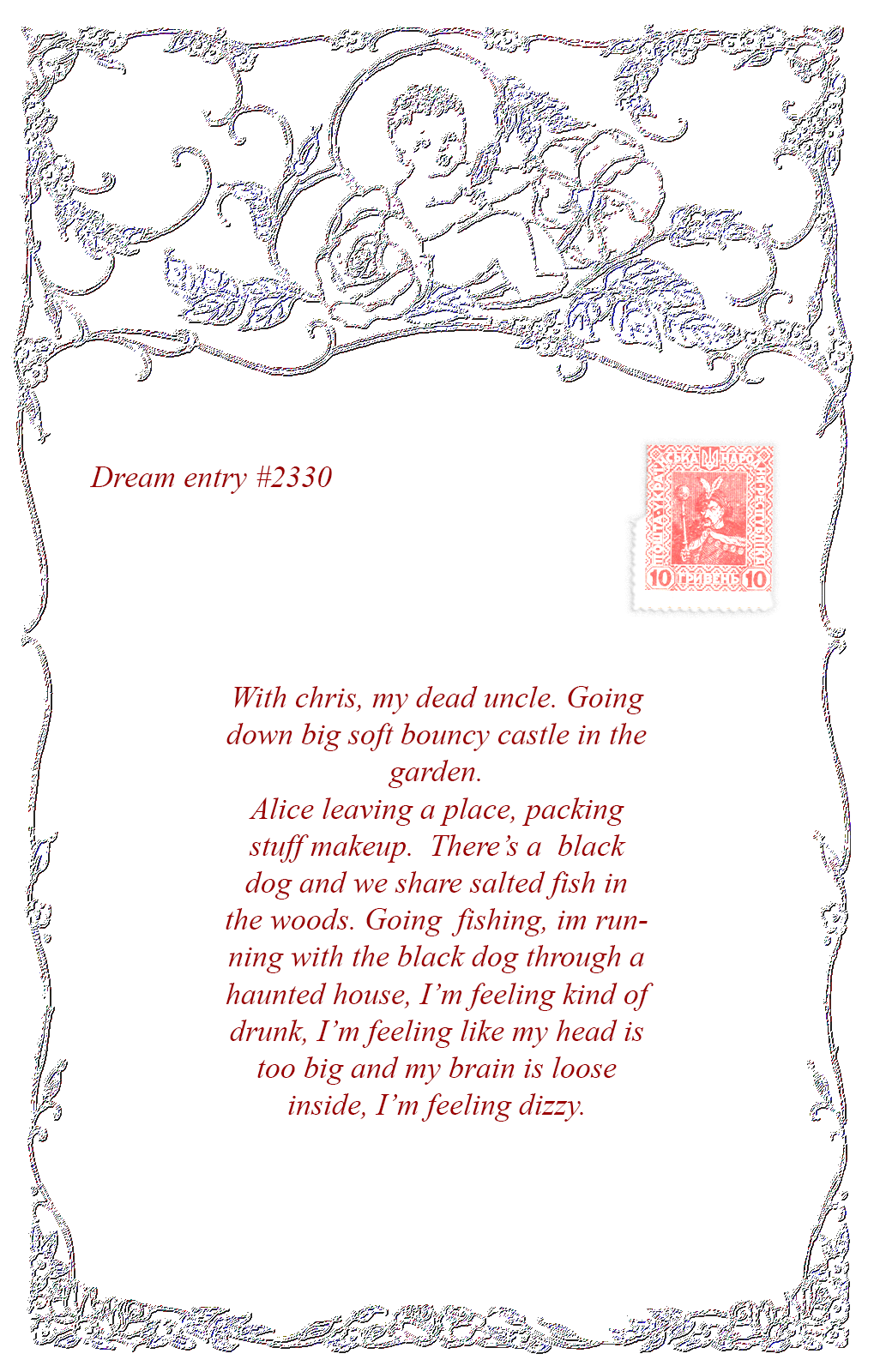


Dream diary entries cycled through AI.